AI-Powered Document Processing in Real Lending Workflows
Many financial institutions have introduced AI powered document processing and AI powered credit scoring into parts of the lending cycle that routinely slow operations down. The shift is often less dramatic than people expect. Most lending operations still handle a mix of structured and unstructured documents every day. Payslips arrive in different formats. Bank statements contain inconsistent layouts. Supporting documents are often scanned multiple times before submission.
In practice, this creates a large amount of operational review work that rarely appears in process diagrams. FinAI’s AI powered document processing capability handles document extraction alongside contextual validation. Institutions working with high application volumes tend to notice the difference during busy processing periods, particularly when applications arrive in batches near reporting deadlines.
The platform includes document intelligence, contextual analysis, signature intelligence, and fraud intelligence within the processing workflow. These are practical capabilities that reduce repeated checking while maintaining visibility into cases that still require manual review.
The operational benefit is usually measured in smaller increments rather than dramatic transformation. Faster turnaround times. Fewer duplicate reviews. Reduced dependency on senior operational staff for routine validation work. Over several months, those adjustments become visible across approval pipelines.
Operational Patterns That Usually Surface First
The first noticeable change is often consistency in document handling. Applications with incomplete information are identified earlier in the process. Fraud indicators become easier to isolate because the platform reviews documents against broader contextual patterns rather than relying solely on extracted fields.
Operational staff also spend less time moving between systems during verification. That matters more than many workflow diagrams suggest. In active lending environments, delays often come from fragmented processes rather than a single major bottleneck.
FinAI’s document processing capability also supports pre-lending activities such as fraud checks, document validation, and credit risk workflows within the same operational cycle.
AI-Powered Credit Scoring Across Approval Cycles
Credit assessment becomes more complex as lending portfolios expand. Institutions begin handling different customer profiles, varied repayment histories, and broader external risk conditions simultaneously. What operations usually need at that stage is not simply faster approvals. They need steadier decision-making under operational pressure.
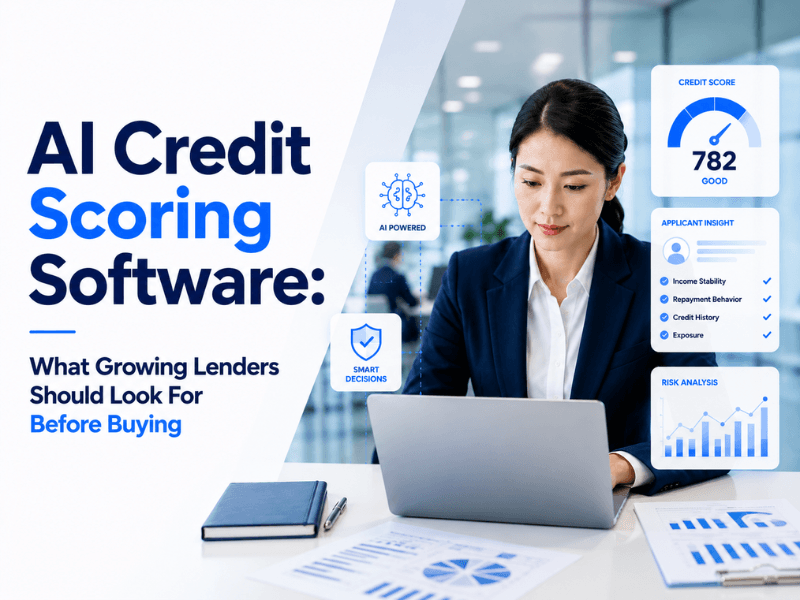
FinAI’s AI powered credit scoring capability supports automated approval workflows alongside risk-based pricing and ongoing credit monitoring. In practice, this becomes useful during periods where application volumes fluctuate sharply across products or regions.
One pattern seen repeatedly in lending operations is how manual scoring reviews expand quietly over time. Initially, only exceptional applications require escalation. Later, review queues widen because operational staff become increasingly cautious about borderline decisions. AI-assisted scoring models help reduce that operational drift by applying more consistent evaluation logic across applications.
The platform also uses internal and external data sources to identify critical risk indicators during decisioning. Operational leadership generally values this visibility during servicing stages as much as during initial approvals. In many financial institutions, the operational conversation around credit scoring eventually shifts toward sustainability. Attention moves away from how quickly approvals move and toward whether the portfolio remains manageable six or twelve months later. That is usually where automated monitoring, restructuring support, and non-performing lending visibility become operationally important rather than simply analytical capabilities.
Book a demo of FinAI today and discover how you can turn hours of document work and credit scoring into minutes of intelligent decisioning.